
Parents looking for daycare for a 2 year old in Irving TX often want more than a safe place for the day. They want to know what their toddler will actually do, how adults will respond when things get messy, and whether the routine will help their child become more capable.
Practical life is one useful part of a Montessori toddler program. Children work with real, child-sized tasks such as pouring water, washing a table, carrying a tray, sorting objects, putting away materials, and helping with snack. The aim is useful participation. The learning grows from doing the task with care and repeating it over time.
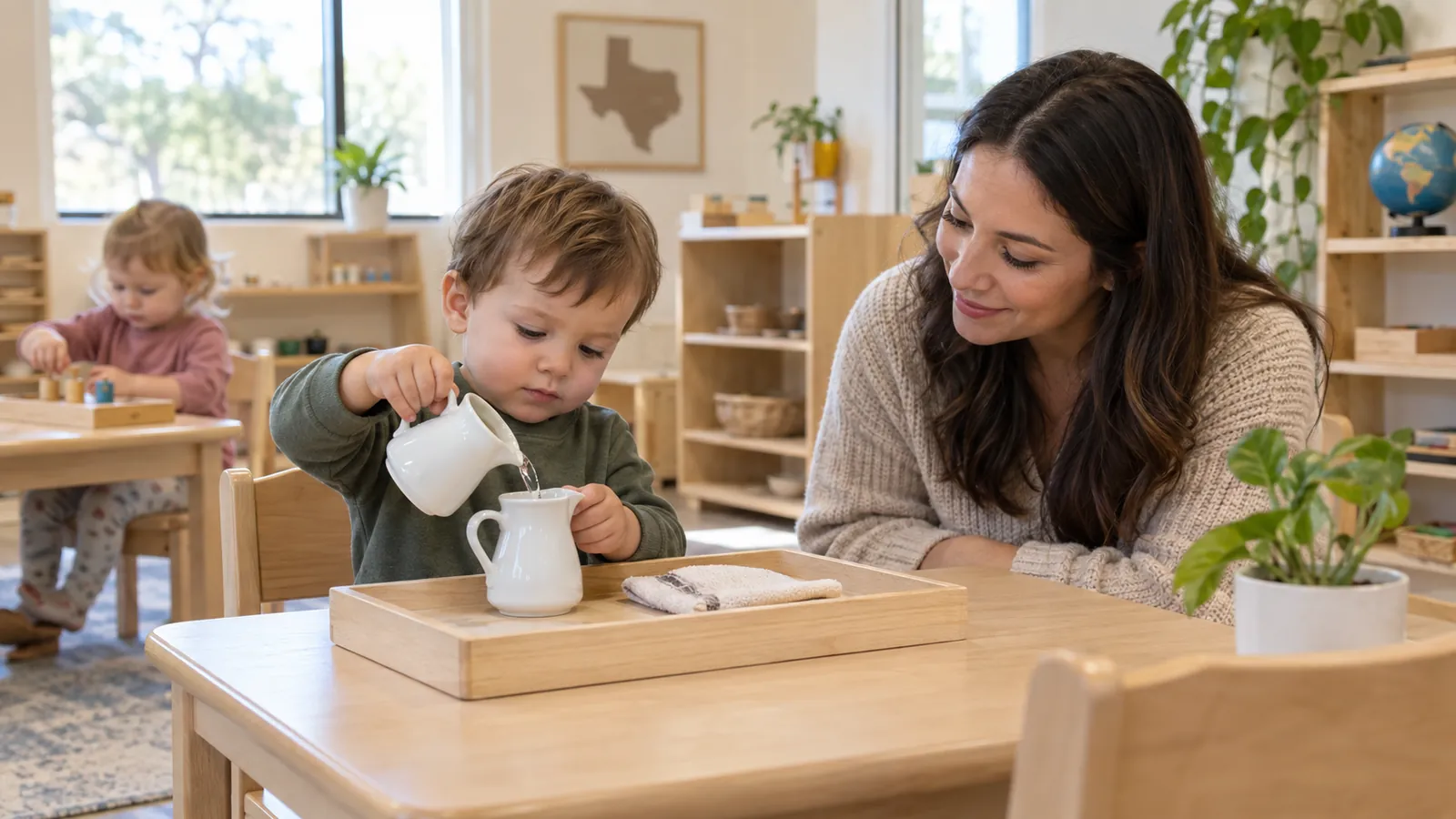
An illustrative toddler classroom scene created for this article.
What practical life means in a toddler classroom
Practical-life work comes from the everyday actions children see around them. A two-year-old watches adults pour drinks, wipe spills, wash hands, carry groceries, fasten clothing, and put objects where they belong. In a prepared classroom, those actions become small activities that fit a toddler’s body and current ability.
A pouring activity might use two lightweight pitchers on a tray with a small cloth nearby. The teacher shows how to hold the handle, steady the second container, pour slowly, and wipe a spill. The presentation is brief. The child can then repeat the activity without an adult talking through every movement.
The task has a real beginning and end. Choose the work. Carry it to a table. Complete it. Clean the space. Return the tray. That order helps a young child understand what comes next, even when the pouring itself is still wobbly.
At Roots Prep School, practical-life work is part of the Montessori toddler environment for children from 18 months to 3 years. The Roots toddler program explains the age range and daily approach.
Why age 2 is a natural time for useful work
Two-year-olds are often eager to copy adult actions. They may insist on carrying their own cup, opening a drawer, sweeping one spot for several minutes, or trying a fastener long after an adult could finish it faster.
This urge can slow down a busy morning, but it also shows a child working out how the world functions. A well-prepared activity gives that effort a safe boundary. The pitcher is small. The amount of water is manageable. The cloth has a known place. The adult has decided which parts the child can attempt and where help may be needed.
The CDC describes milestones as skills that most children, at least 75 percent, can do by a certain age. Its guidance for age 2 includes simple chores, using a spoon, exploring with containers and funnels, and helping with everyday actions. Milestones are a general guide, not a classroom scorecard. Children develop at different rates, and families should share concerns with their child’s healthcare provider.
Texas’s Infant, Toddler, and Three-Year-Old Early Learning Guidelines also organize early development across physical, social-emotional, language, and cognitive domains. Practical work can touch several of those domains during one ordinary activity.
What toddlers practice during practical-life activities
The visible task may be pouring or wiping. The child is also coordinating movement, remembering an order, listening to a short presentation, and handling the frustration of a spill.
| Practical-life activity | What a child may practice | What the teacher can do |
|---|---|---|
| Pouring water | Two-hand coordination, visual attention, control of movement | Use a small amount of water and show where the cloth belongs |
| Transferring with a spoon or tongs | Hand strength, aim, and sustained attention | Choose large safe objects and an easy-to-grip tool |
| Washing a table | Sequencing, whole-arm movement, and care for a shared space | Present the steps slowly and keep supplies within reach |
| Putting on a jacket | Body awareness, persistence, and self-care | Offer time, name one step, and help only where needed |
| Preparing snack | Vocabulary, hand control, and taking part in a group routine | Use child-safe tools and supervise closely |
| Returning materials | Memory, order, and consideration for the next person | Give each item a consistent place on a low shelf |
These activities do not need to look perfect to be worthwhile. A toddler may pour beside the cup, use too much water, or forget one step. The adult can protect safety and the environment without turning every attempt into a correction.
The teacher’s role is active but measured
Leaving room for effort does not mean leaving a two-year-old alone with a difficult task. The teacher prepares the activity, checks that the materials are safe, gives a clear presentation, watches closely, and steps in when the child needs support.
The amount of help should match the moment. If a pitcher is too heavy, the adult can reduce the water. If the child becomes upset, the adult can acknowledge the feeling and simplify the next step. If water reaches the floor, the adult can block the slippery area and help the child find a cloth.
Good support protects the child’s chance to participate. An adult who finishes every task immediately may keep the room tidy, but the child loses the part where coordination and confidence grow. An adult who waits too long may let frustration or risk take over. Skilled toddler teaching lives between those two extremes.
Freedom works best with clear limits
A Montessori toddler room offers choices within a prepared range. Children do not have unlimited access to every object or activity. Teachers select materials for the age group, place them where children can reach them, and show how each one is used.
Limits can be direct and calm: water stays at the table, the pitcher is for pouring, and the floor needs to be dried before someone walks through. The child can choose to repeat the activity or return it to the shelf.
Predictable routines support the same idea. The CDC’s guidance for toddler families says consistent, predictable routines help children know what to expect. In a classroom, a familiar arrival, work period, handwashing routine, meal, outdoor time, rest, and pickup sequence can make the day easier to understand.
Roots is open Monday thru Friday from 6:30 am to 6:30 pm. Families can ask how the toddler routine fits within those hours and how teachers help new children settle during a tour.
Language grows around real actions
Practical work creates a natural reason to talk. The teacher can name the pitcher, handle, water, cloth, spill, full, empty, wet, and dry while the child is handling those objects and noticing those differences.
The conversation does not need to become a quiz. A teacher might say, “The cloth is wet,” or “You poured the water into the small pitcher.” Short, accurate language connects words with an experience the child is already trying to understand.
Children also hear social language during shared routines: “May I use it when you are finished?” “The tray goes back on the shelf.” “I can help with this part.” Those phrases give toddlers a way to take part near other children before they can manage every social moment independently.
The Roots curriculum page explains how Montessori classroom practice works alongside EYFS observations and Texas learning expectations.
What parents can look for on a toddler tour
A practical-life shelf is easy to stage. The more useful questions are how children use it and how adults respond.
During a visit, watch for a few ordinary details:
- materials are complete, clean, and sized for small hands;
- children can reach activities and know where to return them;
- teachers present work with clear movements and limited extra talk;
- spills and mistakes are handled without shame;
- adults step in for safety without taking over every task;
- activities change as children’s coordination and interests develop; and
- the room has time for focused work, movement, meals, outdoor play, and rest.
Ask the guide to show one practical-life activity offered to two-year-olds. Find out how it is introduced, what happens when a child uses it differently, and how the teacher decides that a harder variation is appropriate.
Parents should also ask about communication. A useful update can mention an activity the child repeated, a self-care step they attempted, a word they used, or support they needed. The Roots FAQ covers daily communication, hours, programs, and the enrollment process.
Practical life can continue at home
Home does not need to copy a Montessori classroom. Toddlers can take part in the routines your family already has.
Start with one small job that is safe and repeatable. A child might place napkins on the table, carry clean socks to a drawer, put toys in a basket, wipe a low surface, or pour a small amount of water at snack. Keep the tools manageable and stay close.
Expect the task to take longer than doing it yourself. Use fewer words, show the movement once, and allow another attempt. If the child is tired or uninterested, put the activity away without turning it into a test.
Frequently asked questions
What is practical life in Montessori for toddlers?
Practical life is a group of purposeful, everyday activities adapted for a young child’s size and ability. Toddler examples include pouring, spooning, wiping, handwashing, dressing, food preparation, and returning materials. A teacher demonstrates the steps, supervises for safety, and gives the child time to participate.
Is pouring water appropriate for a 2-year-old?
It can be appropriate when the container is light, the amount of water is small, and an adult supervises. The work area should be stable, with a cloth ready for spills. Teachers adjust the setup to the individual child’s coordination and stop the activity if it becomes unsafe.
Does practical-life work teach academics?
Practical-life activities can support abilities used across learning, including hand control, attention, vocabulary, sequencing, comparison, and following a routine. They are useful experiences in their own right. A school should explain how teachers observe each child and connect classroom activities with its broader curriculum.
What should I ask about a toddler program in Irving TX?
Ask about the daily routine, teacher continuity, group size, communication, toilet learning, meals, rest, outdoor time, and how adults respond to strong feelings. During the tour, watch how children reach materials, move around the room, receive help, and take part in cleanup and self-care.
See practical life in the toddler classroom
Visit Roots Prep School in Irving, watch how teachers guide everyday work, and ask how the routine would fit your two-year-old.