Parents searching for a preschool near Las Colinas TX can end up with a long list of schools that look similar online. A better comparison starts with the parts of daily life that will affect your child and your family: the classroom routine, the adults, the learning approach, communication, hours, and the trip between home, work, and school.
Roots Prep School is in Valley Ranch at 2750 Ranch Trail, Irving, TX 75063. That makes it one option for families who live or work around Las Colinas and North Irving. Before choosing any school, visit your finalists and compare what you can actually observe.
Start with the practical fit
A school can have a thoughtful curriculum and still be difficult for a family to use every weekday. Put the practical questions near the top of your list so you do not fall in love with an option that creates a daily problem.
Check the opening and closing times against your real work schedule. Ask about holidays, late pickup procedures, meals, rest time, and what happens when your child is sick. If you need care across the full workweek, confirm the school is open Monday thru Friday rather than assuming its weekday schedule.
Then test the route at the time you would normally travel. A map estimate at noon may not match the school run before work. Try the drive from home, from the office, or from the sibling pickup that will happen on the same afternoon. Notice where you can park and whether drop-off feels manageable when traffic is busy.
Use the Roots FAQ to see the kinds of schedule and enrollment details worth confirming with every school.
Verify licensing before the tour
Texas Health and Human Services maintains the public Search Texas Child Care tool. Parents can search by location or provider name and review information connected to a child care operation. Use the official record as one part of your check, then ask the school to explain anything you do not understand.
Licensing is a baseline, not a complete picture of classroom quality. The public record cannot tell you how a teacher greets a worried child, how the room sounds during work time, or whether communication fits your family. Those details require a visit and direct questions.
Before the tour, write down:
- the operation name and address shown in the state search
- the ages the program says it serves
- any questions raised by the public record
- the schedule and program details you still need to confirm
This preparation helps you spend the visit looking at the classroom instead of trying to remember basic facts.
Compare the classroom while it is in use
An empty room can look beautiful. A working classroom shows you whether the environment supports children.
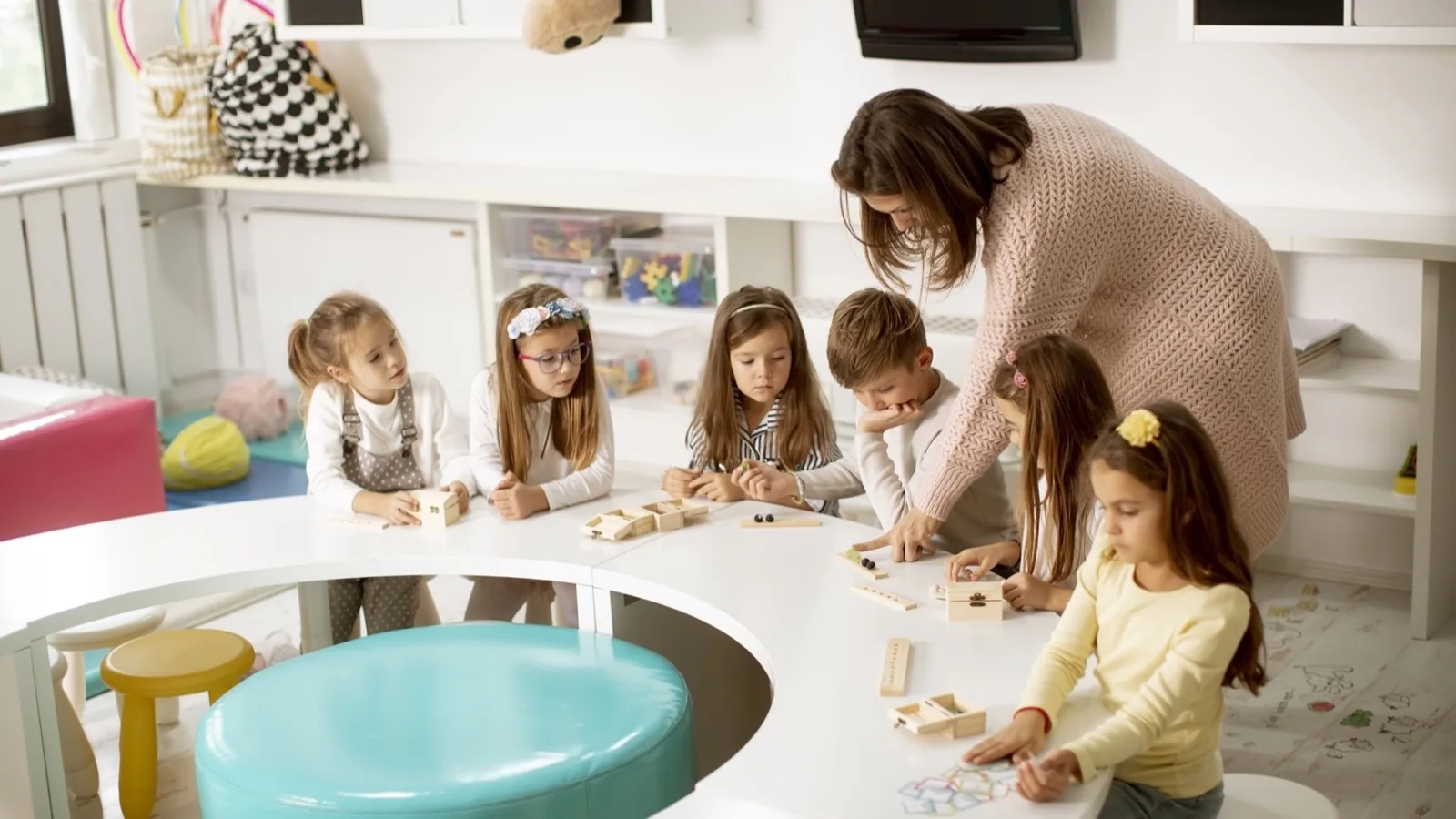
Watch how children move between activities. Are materials within reach? Do children know where things belong? Can they work without constant whole-group direction? Notice whether the room has places for movement, focused work, conversation, and rest.
Listen to the adults. A teacher may need to set a firm limit, comfort a child, or redirect unsafe behavior. The useful question is how the adult handles that moment. Look for clear language, steady attention, and help that matches the child’s age.
Also notice what happens after a mistake. Spilled water, a dropped material, or a disagreement can reveal more about the program than a polished presentation. Ask how teachers help children repair the situation and try again.
Ask how learning works on an ordinary morning
Program labels do not explain the day by themselves. Two schools may both use the word Montessori while organizing time, materials, and adult guidance in different ways.
Ask the guide to describe a normal morning from arrival to lunch. Find out how children choose work, how long they can stay with an activity, when lessons happen, and how teachers decide what to introduce next. If there is a work cycle, ask whether it is protected from frequent interruptions.
At Roots, Montessori shapes the prepared environment, hands-on work, and guided choice. EYFS gives teachers seven connected areas of development to observe, while TEKS keeps preschool learning connected to Texas readiness expectations. The Roots curriculum page explains how those parts fit together.
When you compare schools, ask each one to show you a real example. A broad answer such as “we build independence” is less useful than hearing how children practice dressing, pouring, cleaning up, choosing materials, or asking for help.
Use the same comparison questions at every school
Tour conversations move quickly, and each school will emphasize different strengths. A simple comparison table keeps the decision grounded.
| What to compare | What to observe | Question to ask |
|---|---|---|
| Daily routine | Children know what happens next without being rushed | Walk me through a typical morning for my child’s age. |
| Adult guidance | Teachers are attentive, clear, and respectful during difficult moments | How do you respond when a child refuses an activity or becomes upset? |
| Learning approach | Materials and activities have a clear purpose | How do you decide what my child is ready to learn next? |
| Communication | Staff can explain how families receive useful updates | What will I learn about my child’s day, and how often? |
| Transitions | Arrival, meals, outdoor time, rest, and pickup feel organized | How do you help a new child settle during the first few weeks? |
| Practical fit | Drop-off, parking, hours, and policies work for your routine | Which calendar dates, fees, or schedule rules surprise new families? |
Leave room in your notes for examples. “Warm staff” is hard to compare later. “Teacher knelt beside a crying child, named the feeling, and waited with them” gives you something concrete to remember.
Look closely at communication
Parents often ask whether a school sends photos, but the format matters less than the usefulness of the information. A strong update helps you understand routines, interests, progress, and any concern that needs a conversation.
Ask who communicates with families and how quickly the school contacts a parent about an injury, illness, behavior pattern, or change in eating and sleep. Find out whether you will hear directly from the classroom guide, an administrator, or both.
For younger children, ask how feeding, sleep, toileting, and comfort routines are shared. For preschool children, ask how teachers describe progress without reducing the child to a score or a stack of worksheets.
Check whether the program fits your child’s age now
Families sometimes choose the school they hope their child will need a year from now. Start with the room your child would enter today.
Ask how the environment changes between infant, toddler, preschool, and school-age programs. Look at the size of the furniture and materials. Find out what independence looks like for that age and how adults help without expecting too much too soon.
If your child is approaching preschool, ask how the program supports language, movement, social development, early literacy, early mathematics, and self-care. The Roots programs overview can help you compare the available age groups before a visit.
Make the final decision after the tour
Give yourself a few minutes after each visit to record what you saw. The clearest details fade quickly once several tours blend together.
Rate only the factors that matter to your family. One parent may need a dependable closing time. Another may care most about a calm classroom or the way teachers support language. A third may need infant care and a preschool option in the same school.
If two choices remain close, ask for a short follow-up conversation. Use it to resolve a specific question rather than repeating the full tour. A school should be able to explain its policies and classroom practice in plain language.
Frequently asked questions
How many preschools should I tour near Las Colinas?
Two or three well-chosen tours are usually enough to create a useful comparison without making the options blur together. Screen schools first for location, hours, age group, licensing, and program approach. Then visit the finalists and use the same core questions at each school.
What should I bring to a preschool tour?
Bring your schedule requirements, a short list of questions, and notes about your child’s current routines or support needs. Keep your phone available for practical details such as parking and travel time, but spend most of the visit watching how children and adults use the classroom.
How can I compare Montessori preschools fairly?
Ask each school to describe an ordinary work period and show how teachers introduce materials, observe children, set limits, and communicate progress. Compare specific classroom practices rather than relying on the Montessori label alone. Teacher preparation, room design, daily rhythm, and family communication may differ.
Where is Roots Prep School in relation to Las Colinas?
Roots Prep School is at 2750 Ranch Trail in Irving’s Valley Ranch area, near Las Colinas. Families should test the route at their usual drop-off and pickup times because travel conditions vary by starting point and time of day.
Compare your shortlist in a real classroom
Visit Roots Prep School in Irving, watch the classroom routine, and ask the questions that matter to your family.