Families searching for an EYFS school in Irving, Texas are usually trying to understand what those four letters mean for an ordinary school day. EYFS stands for Early Years Foundation Stage. It is England’s framework for the learning, development, and care of children from birth to age 5.
EYFS is not a Texas licensing requirement. Roots Prep School chooses to use its seven learning areas as a broad view of child development, alongside Montessori classroom practice and Texas Essential Knowledge and Skills (TEKS). That combination helps teachers pay attention to communication, movement, relationships, early academics, creativity, and a child’s understanding of the world.
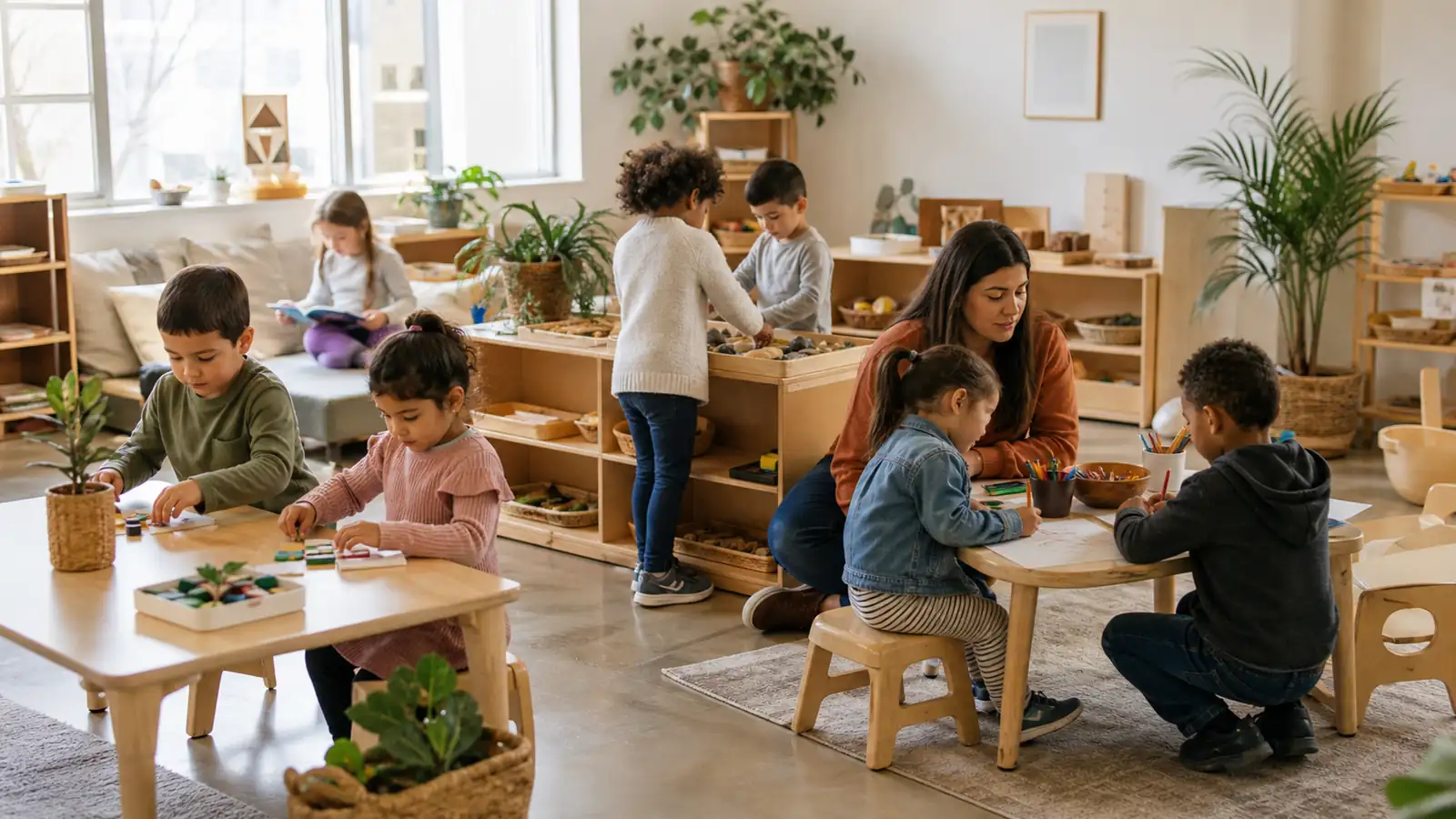
An illustrative early-years classroom scene created for this article.
What EYFS means in plain language
The official EYFS framework sets standards for early-years providers in England. The UK Department for Education describes seven areas of learning and development that are all important and connected. It also describes learning through games and play, with adults observing children and planning suitable next steps.
For a Texas parent, the useful part is the whole-child lens. A child who is learning to count may also be practicing language, hand control, turn-taking, and persistence. EYFS gives teachers a way to notice those connections instead of treating every skill as a separate lesson.
At Roots, the framework does not replace Montessori or TEKS. Montessori shapes how the classroom is prepared and how children choose purposeful work. EYFS broadens what teachers observe across development. TEKS keeps preschool learning connected to Texas expectations for the next school stage. Learn more on the Roots curriculum page.
The seven areas of EYFS
The three prime areas form a base for relationships and learning. The four specific areas build on that base. In a real classroom, the areas overlap throughout the day.
| EYFS area | What parents may notice | A simple classroom example |
|---|---|---|
| Communication and language | Listening, taking turns in conversation, learning new words | A teacher talks with children about a story and gives them time to respond |
| Physical development | Balance, coordination, hand control, healthy routines | A child carries a tray, uses tongs, climbs outdoors, or practices fastening a coat |
| Personal, social, and emotional development | Relationships, self-regulation, confidence, and growing independence | Children wait for a material, ask for help, and work through a disagreement with adult support |
| Literacy | Enjoying books, noticing sounds, mark-making, early reading, and writing | Children retell a familiar story, match sounds, or make a label for their work |
| Mathematics | Number sense, patterns, shape, space, and measure | A child counts objects, compares lengths, sorts shapes, or notices a repeating pattern |
| Understanding the world | People, communities, nature, technology, and change over time | Children observe a plant, talk about family traditions, or test what sinks and floats |
| Expressive arts and design | Art, music, movement, imagination, and making choices with materials | Children mix paint, move to music, build a scene, or act out a story |
The three prime areas
Communication and language grows through back-and-forth conversation. Adults listen to what interests a child, add useful vocabulary, read often, and invite children to talk about what they see and do.
Physical development includes large movements and the smaller hand movements used for drawing, dressing, pouring, and handling tools. It also includes habits connected to health and self-care.
Personal, social, and emotional development covers relationships, feelings, confidence, and self-regulation. A young child may need an adult’s calm support before they can solve a social problem independently.
The four specific areas
Literacy includes enjoying stories, hearing sounds in words, making marks, and gradually connecting spoken and written language. Mathematics grows through real quantities, patterns, shapes, comparison, and everyday problem-solving.
Understanding the world gives children ways to investigate people, places, nature, and technology. Expressive arts and design lets them explore music, movement, materials, color, stories, and imaginative play.
How one activity can cover several areas
Consider a child preparing fruit for a shared snack. The child may wash the fruit, count pieces, learn the name of a new ingredient, use a child-safe tool, wait for a turn, and talk about where food comes from.
That short activity can involve physical development, mathematics, communication, understanding the world, and social learning. A teacher does not need to stop the activity seven times to label each area. The value comes from noticing what the child is practicing and deciding what support or challenge would be useful next.
One experience, several kinds of learning
Prepare fruit for snack
wash and cut safely -> count and compare -> name and describe -> share and take turns -> talk about plants and food
What EYFS observation should feel like for a child
The GOV.UK parent guide explains that EYFS assessment is based on classroom observation rather than a test. For parents, that means progress should be visible in daily experiences: a longer conversation, steadier hand control, more confidence joining a group, or a new way of solving a problem.
Observation works best when adults know the child well. Teachers can note what a child chooses, how they approach difficulty, which words they use, and what kind of help lets them continue. Families add context by sharing changes at home, current interests, languages spoken, and any concerns.
A progress note should lead to a practical next step. A child who loves building may be invited to compare lengths or draw a plan. A child who watches group stories from a distance may be offered a familiar book with one adult or a small group.
How EYFS fits with Montessori at Roots
Montessori and EYFS come from different educational traditions, so parents should ask how a school connects them in practice.
In a Montessori environment, children work with hands-on materials, choose within clear limits, and have uninterrupted time to concentrate. The guide prepares the room, presents materials, observes, and helps when support is useful.
EYFS helps the same teacher look across seven areas of development. A practical-life activity may strengthen hand control and independence. A sensorial activity may invite new language and mathematical comparison. Group songs and stories may support communication, relationships, literacy, and creative expression.
Roots also connects preschool learning to TEKS so families can understand how classroom experiences relate to Texas readiness expectations. The Roots programs page shows how the approach changes with a child’s age.
Questions to ask an EYFS-informed school
Bring questions that reveal what teachers do, record, and share. A school should be able to answer with examples from ordinary classroom life.
- How do you plan across all seven learning areas?
- How do teachers decide when a child is ready for a new challenge?
- What do observations look like, and how often are they shared with families?
- How do you support a child who is developing unevenly across different areas?
- How do home languages and family culture appear in classroom learning?
- How do Montessori work and EYFS observations connect during the day?
- How does the preschool program connect learning to Texas kindergarten readiness?
You can also use the practical questions on the Roots FAQ page when comparing programs.
Frequently asked questions
Is EYFS used in Texas schools?
EYFS is statutory for registered early-years settings in England, not Texas. A Texas school may choose to use its learning areas as an educational guide. Parents should ask how the school adapts EYFS, which parts it uses, and how the approach connects to Texas licensing and learning expectations.
What ages does EYFS cover?
The official framework covers learning, development, and care from birth to age 5. Its areas can help adults observe development across those early years. A Texas school that uses EYFS should explain how expectations change by age and how teachers avoid turning developmental guidance into a rigid checklist.
Does EYFS mean children spend the day doing worksheets?
No. The GOV.UK parent guide says young children are mostly taught through games and play. EYFS educational programs include conversation, stories, movement, exploration, creative work, and early mathematics. The way these experiences appear will depend on the school’s teaching method and classroom environment.
How is EYFS different from Montessori?
EYFS sets out areas of learning and development. Montessori is an educational method built around a prepared environment, hands-on materials, observation, guided choice, and independence. At Roots, Montessori shapes much of the classroom experience while EYFS helps teachers observe development across seven connected areas.
See how the seven areas appear in a real classroom
Visit Roots Prep School in Irving, meet the team, and ask how Montessori, EYFS, and TEKS guide your child’s day.